
I always felt love in my family. As a little kid, I was surrounded by serenity and happiness. My parents and my relatives did all they could to make my brother and me feel loved. My father taught me the importance of love by example. He was always generous and open to help.
At some point, my grandmother (my mom’s mother) and my aunt (my mom’s sister) couldn’t afford to pay rent, so my dad decided to let them live with us for the rest of their lives. Because of his example and my personal experience growing up with my grandma, I did the same thing and had my in-laws stay with us until they both passed away.
Loving my family was easy, but because of that love, I felt it was natural to love my friends as well. I am sure that my family had the usual arguments, problems, and issues that every family would have to various degrees, but I always felt love was there, no matter what happened.
My grandma also taught me that we need to be charitable to strangers – charity being a higher form of love. As long as I can remember, every Sunday morning, she would make orecchiette pasta from scratch, not only for all of us, but also some extra for anyone who could show up at our doorstep unannounced. She used to say: “We are all children of God.”
When I see what is happening in today’s world, a question forms into my mind: “Does the virtue of loving thy neighbour still count?” I’d like to think so, and if applied, it could change this world. Here’s why.
The Command That Crosses Every Border
“Thou shalt love thy neighbour as thyself.” These words, spoken by Jesus Christ and recorded in Matthew 22, are among the most quoted and yet most underestimated instructions ever given to humankind. They are at once simple and staggering — a divine mandate that reaches far beyond the fence lines of our backyards and the borders of our nations. They call us not just to tolerance, but to active, sacrificial, joyful love. And what is remarkable is that this call is not the exclusive property of one faith or one people. Across the great spiritual traditions of the world, the same luminous thread runs: we are bound to one another, and in that binding we find our truest life.

A Foundation in Faith
When a lawyer asked the Savior which commandment was greatest, Jesus answered with breathtaking clarity: love God with all your heart, and love your neighbour as yourself. In the April 2021 General Conference of The Church of Jesus Christ of Latter-day Saints, Elder Gary E. Stevenson of the Quorum of the Twelve Apostles returned to this foundational teaching and wove it together with a remarkable thread of science, scripture, and living example. He reminded us that an ancient prophet had commanded “that there should be no contention one with another, but that [we] should look forward … having our hearts knit together in unity and in love one towards another” (Mosiah 18:21). That phrase — hearts knit together — is not a metaphor for pleasant social interaction. It speaks of a heavenly duty rooted in the Savior’s own answer to the question of which commandment is greatest. To love our neighbour is not an optional instruction for the spiritually advanced. It is the heartbeat of discipleship itself. And for good living.
Elder Stevenson further affirmed that the Lord expects us to teach that inclusion is a positive means toward unity and that exclusion leads to division. This is a bold and prophetic statement in our age of increasing social fragmentation. To choose love over division is not weakness; it is the most courageous spiritual act available to us.
The Abundant Life Is a Life of Love
A few years before, in the 2006 General Conference, Elder Joseph B. Wirthlin another fellow apostle taught what has become one of the great sermons on the quality of a life fully lived. He identified three qualities common to the happiest, most abundant souls he had ever known, and the second of these cuts to the heart of our subject: the second quality of those who live abundant lives is that they fill their hearts with love. Love, he taught, is the essence of the gospel and the greatest of all the commandments — and the Apostle Paul wrote that “all the law is fulfilled in one word, even in this: Thou shalt love thy neighbour as thyself.”
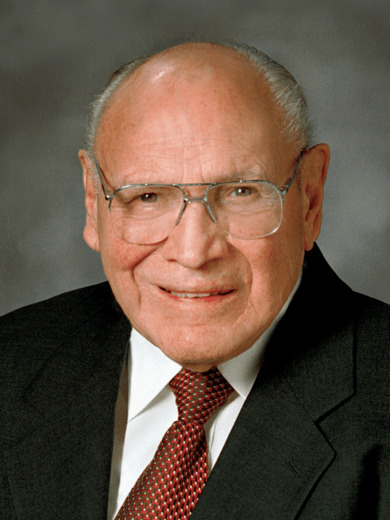
Elder Wirthlin was unsparing in his diagnosis of the alternative. Those who devote their lives in pursuit of their own selfish desires at the exclusion of others will discover that, in the end, their joy is shallow and their lives have little meaning. He contrasted such a life with the radiantly happy people he had known — those who glowed with what he called “irrepressible joy.” The difference was love: outward, active, and often inconvenient love extended to those around them. We are happiest when our lives are connected to others through unselfish love and service. The abundant life, in other words, is not found by looking inward — it is found by pouring ourselves outward. Something my family had taught me since early childhood.
What Science Accidentally Confirms
It would be a mistake to think that this principle of neighbourly love is merely a nice religious idea, disconnected from the hard realities of the world. Elder Stevenson opened his 2021 conference address with a striking story from the world of science. In the 1970s, researchers conducting experiments on the cardiovascular health of rabbits made a puzzling discovery: one group of rabbits — fed the same high-fat diet as all the others — had dramatically fewer arterial deposits. Eventually, they traced the difference to a single researcher. She was an unusually kind and caring individual. When she fed the rabbits, she talked to them, cuddled and petted them. “She couldn’t help it. It’s just how she was.” She did more than simply give the rabbits food. She gave them love.
The results were replicated. The study was published in the prestigious journal Science. Dr. Kelli Harding later built an entire book around this discovery — The Rabbit Effect — concluding that what affects our health in the most meaningful ways has as much to do with how we treat one another, how we live, and how we think about what it means to be human. The gospel principle, it turns out, has physiological consequences. Kindness heals — emotionally, spiritually, and even physically.

A Modern Story
On September 11, 2001, airline passenger Jacqueline Pinto was flying home to New York from a vacation in Italy. During the flight, she heard the pilot announce a delay in landing, but did not realize how serious the situation was until her plane landed a thousand miles away at Gander International Airport in Newfoundland, Canada. Hers was one of more than 250 flights forced to divert to Canada because of the closing of American airspace. Thirty-eight commercial flights touched down in Gander that day.
The mood on Pinto’s plane changed from confusion to shock as news of the terrorist attacks reached the cabin via phone calls and announcements from the cockpit. Pinto spent more than 24 hours confined to the plane with her fellow passengers and the crewmembers as security personnel examined each diverted aircraft.
Finally cleared to disembark and go through customs, Pinto, the passengers, and the crew left the airport by school bus. Neither Gander, with a population of nearly 10,000, nor towns in the surrounding area had enough hotel space for approximately 7,000 stranded passengers. Local residents responded.
Community television stations put out a call to “lend a hand, do what you can.” Schools and nonessential businesses were closed, allowing Newfoundlanders, from senior citizens to schoolchildren, to volunteer.
Greeting the “plane people” with warmth, locals provided meals, clean bedding, and hot showers. Schools, churches, and legion halls were converted into makeshift dormitories. Some residents, including Derm Flynn, the mayor of the town of Appleton, even invited visitors to stay in their homes. The passengers on Pinto’s flight were sheltered in a church in the town of Lewisporte.

Area pharmacies filled prescriptions without cost, banks of free public telephones were installed so visitors could call home, and donations of toiletries, clothing, and food flowed in. Much of the food was stored at the Gander Community Centre’s ice rink, turning it into “the largest walk-in freezer in the country,” according to Gander’s mayor, Claude Elliott.
Once basic needs were met, the Newfoundlanders worked to entertain the visitors. They organized tours of the town, bowling matches, and concerts by local bands. Visitors also were introduced to regional cuisine, including stewed moose. When asked about their generosity, many residents responded that their efforts were not out of the ordinary. “For us, it was just every day,” said Janice Goudie, a local newspaper reporter. “You don’t turn your backs on people in need.”
What made Gander and the surrounding towns places of refuge? Not geography. Not policy. Not shared religion. It was simply the decision of ordinary men and women to love their neighbour — to see suffering and respond with open hands. This is the commandment made real.
The Jewish Tradition: “That Which Is Hateful to You, Do Not Do to Another”
Long before the Christian era, the commandment to love one’s neighbour was embedded in the heart of Jewish thought. The book of Leviticus (19:18) states plainly: “Thou shalt love thy neighbour as thyself: I am the LORD.” This is not a vague aspiration — it is Torah, divine law. The great Rabbi Hillel, who lived in the generation before Jesus, was once challenged by a sceptic to teach the entire Torah while standing on one foot. He replied: “What is hateful to you, do not do to your neighbour. That is the whole Torah; the rest is commentary — go and learn it.” The principle is not peripheral. In Jewish understanding, it is the very centre from which all other ethical teaching radiates.

The Jewish concept of chesed — often translated as loving-kindness — goes even further, describing a kind of covenant loyalty, an unconditional goodness that one extends to others not because they deserve it but because it is right. Tikkun olam, the repair of the world, is a further expression of this: every act of neighbourly kindness is a contribution to healing a broken world. Love thy neighbour is not merely personal virtue; it is cosmic responsibility.
The Islamic Tradition: The Neighbour in Sacred Law
In Islam, the status of the neighbour is elevated to a sacred trust. The Prophet Muhammad (peace be upon him) is reported to have said: “He is not a believer whose stomach is filled while the neighbour to his side goes hungry.” In another hadith, he declared: “By God, he does not believe! By God, he does not believe! By God, he does not believe!” When asked who was meant, he replied: “One whose neighbour is not safe from his evil.” The neighbour — whether Muslim or not — holds a protected status in Islamic ethics. The Quran (4:36) commands Muslims to show kindness to parents, relatives, orphans, the needy, the near neighbour, the distant neighbour, and the companion at one’s side. The circle of duty is remarkably wide.
This teaching flows from the Islamic understanding that all human beings are creatures of God — that to honour a neighbour is to honour the One who created them. The Arabic concept of rahma (mercy and compassion) is central to this vision: God is al-Rahman al-Rahim — the Most Gracious, the Most Merciful — and those who walk in His path are called to embody the same qualities toward those they encounter.
The Bahá’í Faith: Unity as the Foundation of All Virtue
The Bahá’í Faith places the oneness of humanity at the absolute centre of its teachings. Bahá’u’lláh, the founder of the Faith, wrote: “O Children of Men! Know ye not why We created you all from the same dust? That no one should exalt himself over the other.” This is not a social philosophy borrowed from the age of Enlightenment — it is a spiritual principle rooted in the conviction that God created all people as members of one family.
The Bahá’í commitment to the neighbour flows from this: if we are one family, then every neighbour is a sibling. The ‘Abdu’l-Bahá, son of Bahá’u’lláh, taught: “If you are not happy and joyous at this season, for what season shall you wait and for what time are you reserving yourself?” He consistently modelled active love toward neighbours of every background, visiting the poor, feeding the hungry, and extending friendship across every social and religious boundary. For Bahá’ís, world unity is not utopian dreaming — it is the practical outcome of taking the commandment to love one’s neighbour with absolute seriousness.
Loving Our Enemies: The Hardest Frontier
Perhaps the most challenging dimension of the commandment is what the Saviour added in His Sermon on the Mount: “Love your enemies, bless them that curse you, do good to them that hate you.” Elder Stevenson addressed this frontier directly in his 2021 address. As we strive to extend ourselves in love, respect, and kindness, we will undoubtedly be hurt or negatively affected by the bad choices of others. We follow the Lord’s admonition to “love your enemies … and pray for them which despitefully use you.” We do all we can to overcome the adversity that is placed in our path, all the time praying that the hand of the Lord will change our circumstances.

This is not passive acquiescence to injustice. It is the most active spiritual discipline imaginable — choosing to hold another person in a posture of love even when they have wronged us. When adversity and affliction are brought upon us by critical, negative, even mean-spirited acts, we can choose to hope in Christ. The ability to love one’s enemies is, in this sense, the fullest expression of what it means to follow the Prince of Peace. It is also, history shows, often the beginning of reconciliation — the act that breaks the cycle of retaliation and opens the door to healing.
Kindness Is Not Passive — It Must Be Chosen
A thread running through all these great traditions is that neighbourly love is not a feeling to be waited for — it is a discipline to be practised. Elder Stevenson issued a gentle but firm challenge to members of the Church: President M. Russell Ballard taught that Latter-day Saints must be kind not only to each other but also to everyone around them — and that behaviour which overlooks or excludes those of other faiths is not in keeping with the teachings of the Lord Jesus Christ. Kindness, in other words, must be chosen — and chosen especially when it is inconvenient, when the person before us is different from us, when the crowd is moving in a different direction.
Elder Wirthlin illustrated this with the story of the Prophet Joseph Smith, who welcomed a group of African American travellers who had walked hundreds of miles in winter to reach Nauvoo. When one girl, Jane, arrived without a place to stay and wept, not knowing what to do, Joseph turned to Emma and said, “Here’s a girl who says she doesn’t have a home. Don’t you think she has a home here?” Emma agreed, and from that day on, Jane lived as a member of the family. Years later, Jane said she would still wake in the night and think of the Prophet’s goodness to her. One moment of chosen kindness echoed across a lifetime.
The Promise: Healing Hearts
We return at last to where we began — to the promise. Elder Stevenson closed his address with these words: “As you extend yourself with kindness, care, and compassion, I promise that you will lift up arms that hang down and will heal hearts.”
To love thy neighbour is to participate in something larger than ourselves. It is to enter into the great project of God — the knitting together of hearts across every difference of race, religion, language, and background. Whether we approach it through the lens of the restored gospel, ancient Judaism, Islamic rahma, Bahá’í unity, or the broad Christian tradition, the call is the same. The world does not need more bystanders. It needs more people who see a suffering stranger and say, as Joseph Smith said to Jane: You have a home here.
That is the commandment. That is life. And in living it, we discover what it means to be fully human — and perhaps, to become a little more divine.
adf







Leave a Reply